1
Build an alien vocabulary
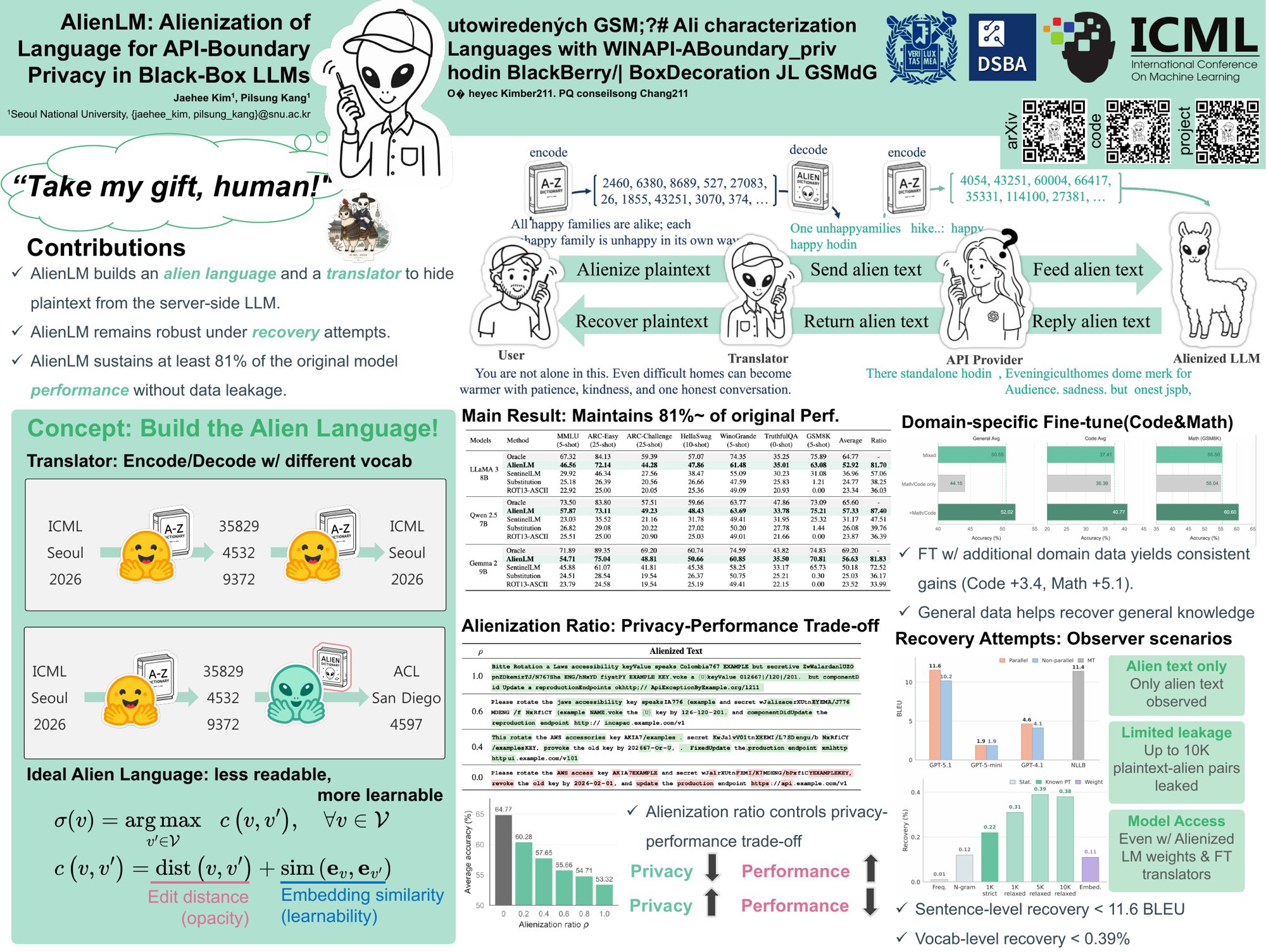
A vocabulary-scale token bijection makes surface strings unreadable while keeping token relationships useful for adaptation.

AlienLM rewrites your prompt into a private language before it ever reaches a black-box LLM. Same answers, zero plaintext on the wire.
Your text and its alien twin share the exact same token IDs — only the dictionary that spells them out is swapped. Encode with yours, decode with the alien one, and the surface text turns unreadable while the model still understands every token. The provider processes gibberish; your client quietly reads it back.
Built to deploy with nothing but API-only fine-tuning and public tokenizer information.
A vocabulary-scale token bijection makes surface strings unreadable while keeping token relationships useful for adaptation.
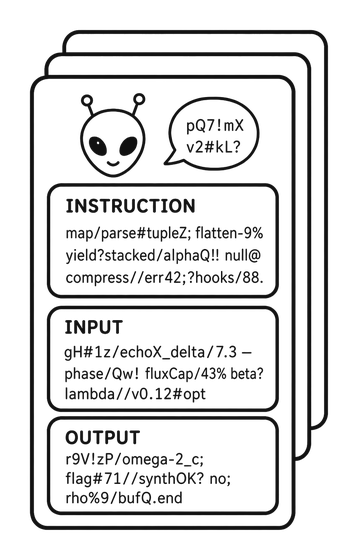
Alien Adaptation Training teaches the target model to operate directly on alienized inputs using standard fine-tuning APIs.
The client encodes natural text into alien before the API call, and decodes the alien response right after it.
Pick an alienization level ρ and watch a prompt cross the API boundary with Llama 3's real tokenizers. Tokens that keep their original surface stay plain; alienized tokens light up. Everything runs client-side; no text ever leaves your browser.
Averages across MMLU, ARC, HellaSwag, WinoGrande, TruthfulQA and GSM8K, plus recovery robustness under three observer scenarios.
AlienLM keeps >81% of plaintext-oracle performance while beating random-bijection and character-level baselines.
| Backbone | Oracle avg. | AlienLM avg. | Ratio |
|---|---|---|---|
| LLaMA 3 8B | 64.77 | 52.92 | 81.70% |
| Qwen 2.5 7B | 65.60 | 57.33 | 87.40% |
| Qwen 2.5 14B | 73.49 | 62.05 | 84.43% |
| Gemma 2 9B | 69.20 | 56.63 | 81.83% |
Paper for concepts, Hugging Face for checkpoints, GitHub for tokenizer, training and recovery code. The poster, the figure cast and a BibTeX entry are below.
ICML 2026 paper and arXiv version history.
AlienLM checkpoints, random baselines and ratio variants.
Translator utilities, tokenizer init and the ICML snapshot.
Runnable O1/O2/O3 recovery and robustness scripts.
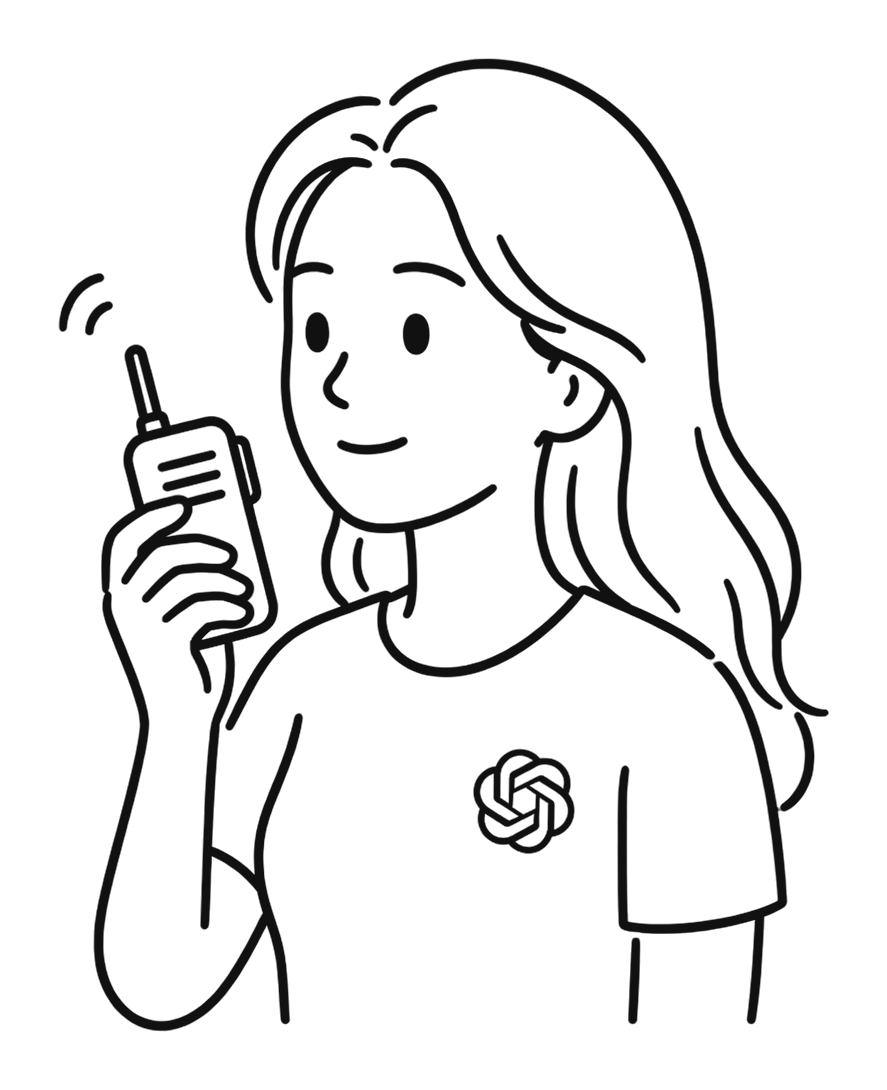
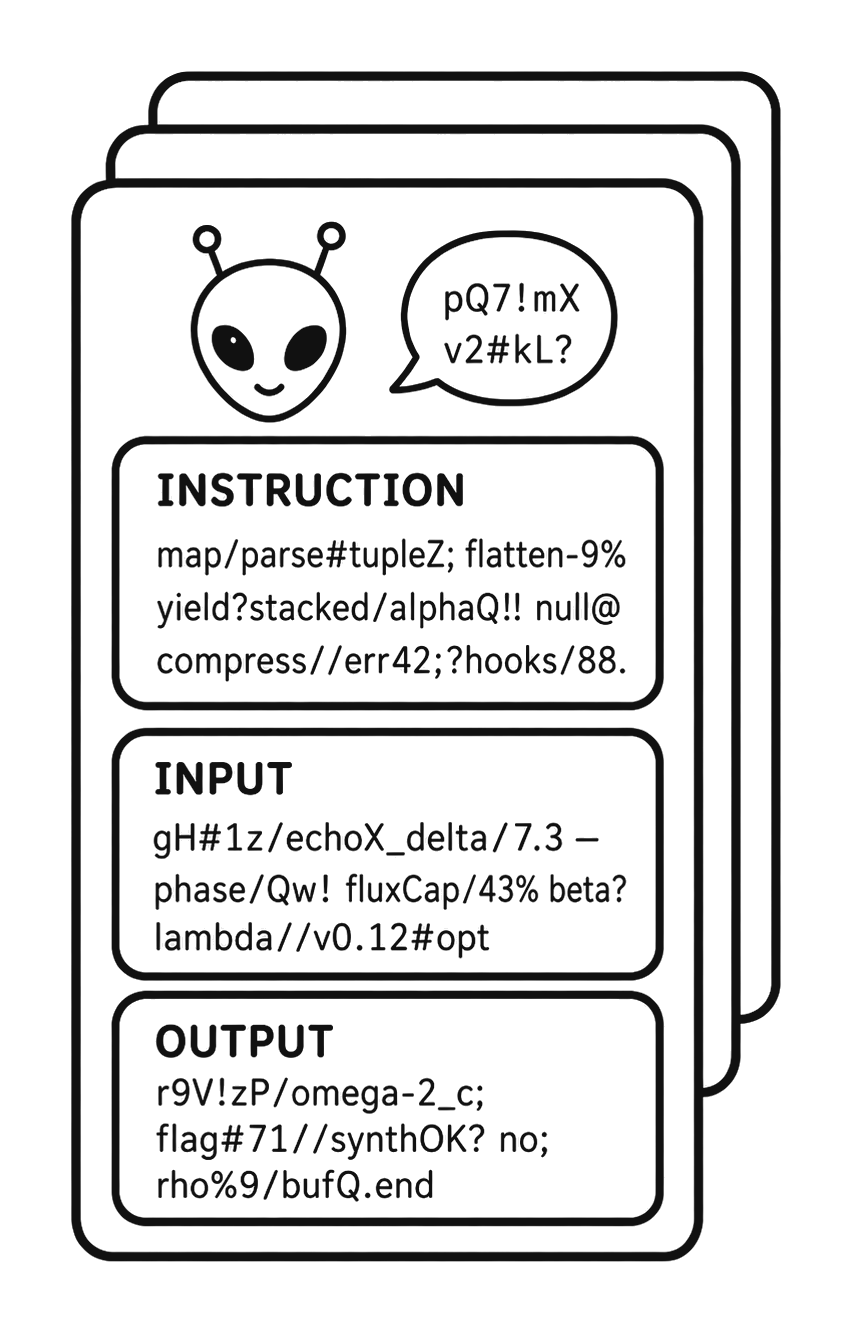
The cast of the paper's figures, as transparent PNGs. Reuse them in slides or posts, with a credit to AlienLM (Kim & Kang, ICML 2026).
The logo on the API provider's shirt is OpenAI's trademark and is not part of that permission.
@inproceedings{kim2026alienlm,
  title     = {AlienLM: Alienization of Language for API-Boundary Privacy in Black-Box LLMs},
  author    = {Kim, Jaehee and Kang, Pilsung},
  booktitle = {Proceedings of the 43rd International Conference on Machine Learning},
  year      = {2026}
}